Cambrian Railways 1st/3rd Composite No 110
Believed to be the only Cambrian Railways carriage being actively restored for passenger service on a heritage railway.
Background
The Cambrian Railways Company was one of the smaller pre-grouping railway companies. Itself the amalgamation of five minor concerns, it served mid-Wales and a stretch of the Welsh coast. It was taken over by the GWR in 1922.
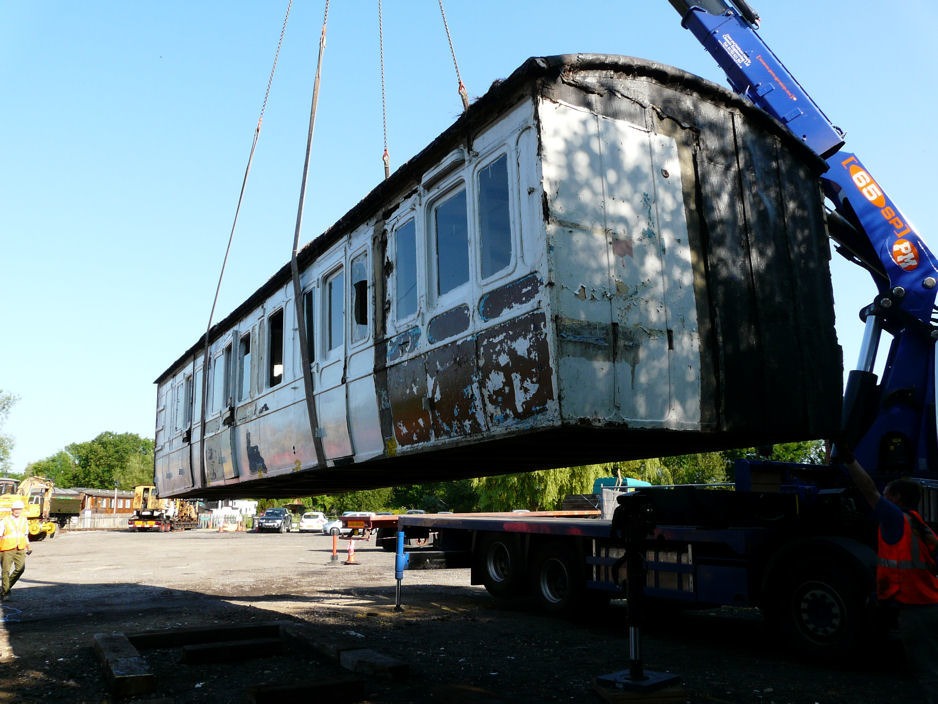
No 110 arrives at the Swindon & Cricklade Railway from Hayle in Cornwall.
Carriage
No 110
Carriage No 110 is a six-wheeled First/Third class semi-corridor lavatory composite with a separate luggage compartment. It operated as a through carriage between London and the Welsh coast, being worked as part of a GWR or L&NWR train before being attached to a Cambrian Railways train for the last part of the journey. Its arrangements meant that passengers would arrive with their luggage in the same vehicle, regardless of being shunted from train to train in the course of their journey.
No 110 is believed to be unique in preservation. Built in 1894, it is probably amongst the last ‘prestige’ six-wheel stock built for the Cambrian. Two years later, the company was building bogie coaches for its Through Carriage services.
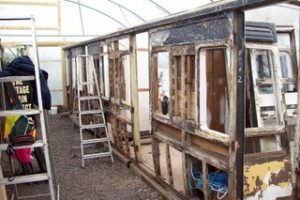
FIRST STRIP IT ALL DOWN. DOORS AND WINDOWS OUT, REMOVE ALL ROT AND DAMAGED TIMBER. LOOKS A MESS AFTERWARDS!
Subsequent life
Once sold out of railway service, No 110 was converted, as a ‘grounded’ body, into a holiday home at Hayle in Cornwall in 1934, and fell out of use around 2000.
In this latter, abandoned, state it was heavily attacked by wet and dry rot but, with the basic structure largely intact, and in view of its unique status, it was felt to be well worth saving.
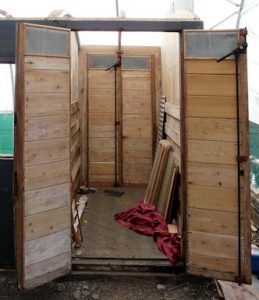
Both sets of luggage compartment doors have been re-hung.
At the railway
Initial work concentrated on removing all rotten and diseased timber and applying preservatives. This left a largely empty shell with no roof, areas of floor missing and some main timbers to be replaced.
First all the floors and partitions were completed, the frames for the internal corridor walls erected and seat bases installed. This included turning all the new legs required. New panelling was completed on both sides and ends. The doors were all refurbished (a big job!), plug-in window modules were made up using toughened glass, and new droplight window kits were made as an exercise by the local college.
Work then proceeded on the exterior mouldings, these being loosely fitted as an interim step. A completely new roof was put on, the boards being seasoned for several months to allow any natural curvature to develop. Panelling in the first class compartments was then restored using original wood whenever possible. Sapele with walnut stain was used instead of walnut, and maple was used instead of the original sycamore. False ceilings were installed, and a representation of the first class toilet finishes the job.
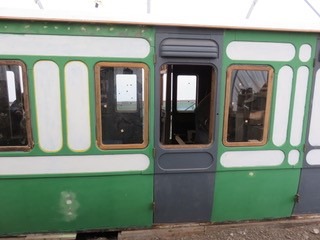
Considerable research has been done to get the correct Cambrian Railways colour scheme. Possibly not the most attractive in the world but we believe that it’s authentic, though the complicated lined has had to be simplified. We will soon be “scumbling” the 3rd class compartments, scumbling being the art of painting wood to look like wood!
With much work on the carriage body completed or entering its final stages, we began to explore alternatives for its chassis. The initial intention has been to provide a replica of the vehicle’s original six-wheeled running gear. However, apart from the production costs anticipated, and problems with track geometry, it was decided to use the existing chassis from a ‘long’ ex-BR CCT because this would effectively remove many of the problems anticipated with the original scheme.
Mounting the body on its donor chassis will be a complex task, and we await the availability of suitable covered space. Meanwhile, there is still plenty of internal detail work to keep us busy for the coming months.
It might be noted that converting six-wheeled carriages to four wheeled was often carried out by the GWR on stock inherited at the Grouping.
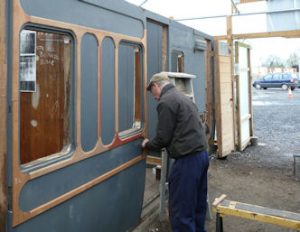
Test fitting the first of the new external mouldings.